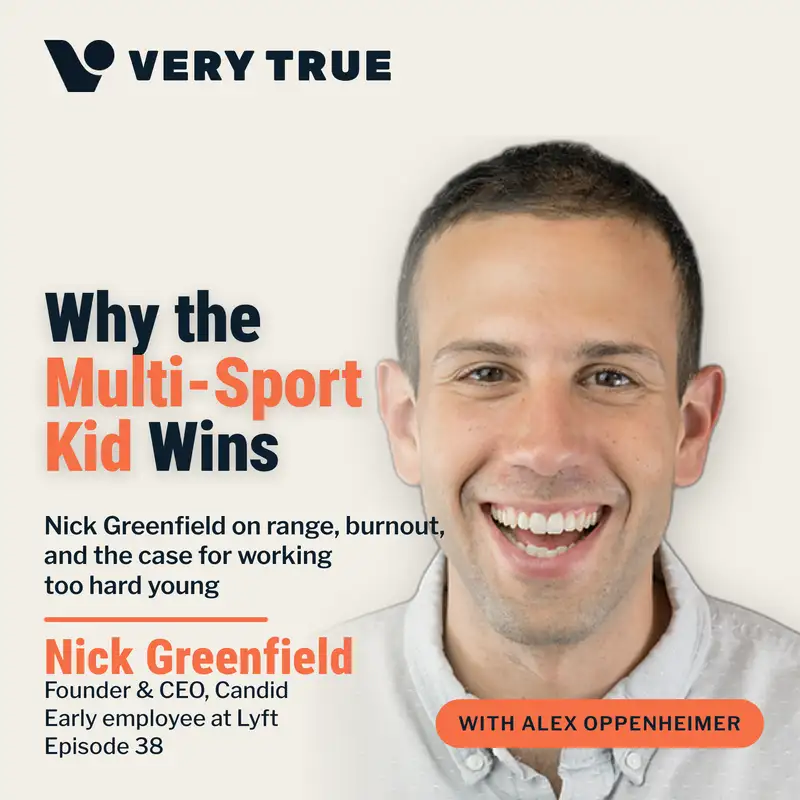
Why the Multi-Sport Kid Wins - Nick Greenfield on range, burnout, and the case for working too hard young
Alex (00:01)
Welcome back to Very True. I'm Alex Oppenheimer. I sat down recently with one of my oldest friends, Nick Greenfield, and we talked for almost two hours. Too good to cut down to one episode, so I'm releasing it as three separate episodes. These three are not a series you have to take in order. Each one stands on its own. If the title of part two or part three is what grabs you, start there. You won't be missing any setup. I split them by subject, The first one is about the early part of a career, the stuff nobody prioritizes for.
Because it doesn't show up on a resume. Nick and I met at Stanford almost 20 years ago. He was a multi sport kid who never went pro at any of them. And that mattered more than if he had. We get into range versus being spiky, why the best class I took in college to prepare for investment banking was rocket science and the case for working harder than is reasonable when you're young. We cover everything from the importance of value based mentors to San Francisco startup culture 15 years ago. If you're early on in your career or you manage people who are, I think you'll enjoy this conversation.
Let's get into it.
Alex (01:52)
Okay, welcome back to another episode of Very True by Verissimo. Today I'm really excited to have on one of my very, very good friends, Nick Greenfield. And he's not just like my very good friend, how like every podcaster says, I'm such good friends with this person. Nick and I met at Stanford in 2008, towards the end of freshman year, basically because we had one really important thing in common, which was that we both had freshman year randomly assigned roommates who were on the football team.
And so we ended up in the same fraternity through them. and we've been friends ever since. That was almost 20 years ago. So lots of motions in between, lots of different cities, lots of experiences, mostly ups, a couple downs, but that's how we live. and I'm really excited to have a conversation that can encompass so many different aspects of professional life.
Nick (02:42)
Yeah.
Alex (02:43)
and I think Nick has a lot to offer. So I'll kick it off by sending it over to him to take us way, way back, as far back as you're comfortable going for where you came from, to give the context and the picture of how you got to where you are now.
Nick (02:59)
Great. Let's start at home run baseball camp, where I was a player and a and then eventually a a coach through high school. coach John John McCarthy, one of the legends of DC area baseball. Haribka is the HRBC acronym. And Coach Mac, as we called him, loved to teach young boys and some girls.
Who attended the baseball camp, life lessons through baseball. And I think that those apply all the way through today. And on the hat for the camp, there was the wheel of success, which was fun, safety, hustle, and do it the right way. And while I don't necessarily directly worry about those things every day, I think that that has translated over the last call it 25 or 30 years into how I approach business, how I approach life in general.
How I continue to approach sports. He asked what fruits and vegetables you were eating. He asked what books you were reading. He ensured that you were making good eye contact and he rewarded those behaviors. Well, of course, this was a baseball camp, so it wasn't how hard you were throwing or how fast you were running or how far you hit the ball, but it was those components at home run baseball camp that I think have played all the way through. And it's great because there's a whole alum network of Coach Mac disciples who continue to kind of play that way. And
Coach Mac then had two programs where he he was running a very good business in the baseball camp, but he also had elementary baseball, which was for young children in the DC area who didn't have access to high quality after school activities, and he was able to provide books, reading, funding, and of course baseball education in inner city Washington, DC. And then he also started a group called baseball libros.
Which was a school in the Dominican Republic that he was funding with five hundred plus kids that were outside San Pedro de Macorís in a little little town. And he would take us down to go play. We'd read and teach in the morning and then play baseball in the afternoon. So I think that that was definitely formative for me in just my approach of not only, you know, how do you be a great athlete, but how do you really be a great person? And
apply what you have to helping as many people as you can. And, you know, Coach Mac is somebody I I try to stay in touch with. He wrote my college recommendation 20 years ago. And from there, you know, just try to kind of channel him whenever I can.
Alex (05:27)
That's amazing. That's incredible. That's like the the greatest background origin that you can possibly offer up. But and so I'll preview and let's spoil a little bit later in the story. did you become a professional baseball player?
Nick (05:38)
Unfortunately, did not fulfill my dream. my fastball was not quite what it needed to be.
Alex (05:43)
Did you become
a college baseball player?
Nick (05:45)
Did not become a college
baseball player. I could have, played D3 baseball, but instead, I played ultimate, also known as Ultimate Frisbee in college. as many ex-high school athletes go and realize they they're not quite good enough to play their you know, D three or D1 sports, they end up playing Ultimate Frisbee. And that was definitely defining for my first
probably even five to seven years out of college. you know, I everything was about how do I continue to play Ultimate. And that was one of the things that led me down the career path, which I which I ended up going down over the past twenty years.
Alex (06:20)
I think this is one of the most interesting subjects everyone's talking about right now. I recently started reading the book Range, which is, I don't know if you're familiar with it, but it's really through the lens of athletes. I only read the intro so far. And the intro contrasts two kind of two of the world's greatest in different sports. One being Tiger Woods, who was like on TV hitting golf balls like age two and a half, and the other being Roger Federer, who played all kinds of different sports.
Who grew up in a family of athletes and played all kinds of different sports and then didn't really start taking tennis competitively seriously, I think, until high school. And I think that in the world we live in now, definitely for like junior athletics, but also for the professional world, things just kind of keep creeping younger and younger in terms of hyper-focused optimization around like.
finite
skills. And I think that that filters into the professional world that we live and work in today, right? I I you hear this term called like being spiky. People want spikiness. People want someone who's like the best in the world at X. and you know, if you look at colleges, they want people that are like again, they won a cancer research award when they were thirteen, you know, and like they're the number one prospect in XYZ sport or whatever it may be, won some art award.
But the people that end up being, I guess, I don't know if I want to call it like risk-adjusted, the most successful are usually the ones who had an experience, I think like the one you had, which is in a certain context, but with implications to much broader life. and that's I didn't know that story about, you know, this baseball coach. It also, you know, brings up ideas in my head about I know if you've heard of Alpha School, but like this is what they're doing, where they're hyper optimizing.
the education for kids on how those kids learn, but really importantly, they're pairing them with a coach and with a teacher, that person that can inspire them and instill values, which are the gonna be the things that continue to motivate them long into the future. So that's amazing. very, very cool. So then what?
Nick (08:20)
well I think to your point of of spikiness versus diversification of experience, I I definitely was on, you know, many standard deviations to the right of diversity of experience. I played baseball, basketball, football, soccer growing up. I did quiz bowl and it's academic. I did theater. I was in a high school a cappella group and did choir. And I think that where I came from.
the diversity of experience was definitely more valued than just being really, really good at a young age at one thing and trying to not only develop your body but also your brain in from many directions to be flexible and be go into any situation and then have a growth mindset, right? Like you can figure anything out. You can play any game. You can, you know,
win at spike ball when you're playing with your friends on the beach and you can also train to run a race or you can bike or you can swim or you can do math or physics or you can read. Like all of these things come together. I think we in the in the last, you know, twenty years have become obsessed with like solo focus on one thing. But I don't know if
the that's actually how the brain necessarily develops. And I don't think anybody really knows, if you focus really hard on just doing chess, that you're gonna be the best chess player, it may turn out that diversity of experience develops the brain in new ways and you can think strategically in from different angles. So I think a lot of us are operating without appropriate data there. And it comes down to kind of your instinct or following what others are doing. you and I both know that we're we don't like to be people that follow what others are doing. And
I appreciate the diversity of experience and allowing, for example, now that I have kids, allowing them to do as many different things as possible to see what they like. And you know what? That's not just gonna be until they're four or five. That's gonna be until they're twelve or fourteen or fifteen. And if you know, your kid says, Hey, I really want to play travel soccer and, you know, spend all my weekend doing soccer, great. That's self, that's that's driven by the that individual and what they want to do. But I think forcing
Kids, especially at young ages, can pigeonhole and burn them out. I definitely, I mean, I was at least at a younger age, was was a victim of burnout. I I did that to myself playing a lot of baseball and ended up taking a year off. And it definitely hampered my potential future prospects. but I also, you know, you you end up burning yourself out if you do the same things over and over again. so yeah, from from there, I'll just quick, quick career trajectory, first kind of
I would say desk-ish job was I was a youth reporter at WAMU, which was the DC area NPR affiliate. I did that for a couple of summers and covered both a couple of different beats, like the Anacostia River, and then did some specific news stories and got to live inside of a newsroom. that's where Morning Edition is recorded, and some other kind of nationally syndicated broadcasts. So it was a
really, really cool experience going through it. And I was at the time very interested in international relations and political science, which was what I majored in in college. but also the idea of of news in general, which of course recently has gotten, I would say, a bit of a bad rap. deserve it or undeserve it, I'm I'm not sure. But definitely being in that newsroom where there was a real search for the truth and production quality was was an amazing
kind of first career experience. Did a couple internships in college, but ultimately the thing that I got really passionate about was playing Ultimate at a high level. and career-wise, in when I was graduating, I had two options. I could either go to Brazil and work at a company called Peche Urbano, which was the leading daily deals site. So I think Groupon, 2011 Groupon of Brazil.
or stay in San Francisco and play Ultimate. And I decided, you know what? I'm gonna stay in the Bay Area. I wanna play Ultimate, I'll have a job so I can, you know, afford to live. And yeah, from there I got really lucky.
Alex (12:26)
Yeah.
So coming out of college, like you know, I I did an internship in investment banking after my junior year. I didn't really
Nick (12:36)
Which by the way,
I didn't know what investment banking was. I think you had to explain it to me. Like you were a year in before I even understood what that meant.
Alex (12:43)
I'm still trying to figure it out.
but isn't isn't there a story about your dad like working with Mitt Romney at BCG or something?
Nick (12:49)
Yes, consulting I knew what it was. And I was I was not allowed coming
go when I went to college, I wasn't there were a few jobs I wasn't allowed to have. I wasn't allowed to be a lawyer and I wasn't allowed to be a consultant. So I knew that those two were out.
Alex (13:01)
yeah, and like I I recruited into that. I worked at a boutique, I didn't like it, and then I went to a big bank and you know I got that experience and I kind of had the skill set, I guess. Like I, you know, I studied mechanical engineering, and even if you study finance, you don't have the skill set. I think that's like a real misnomer for kids going to college, like
Even even like computer science, like the number of people I know that became software engineers that did not study computer science
Nick (13:27)
I I would argue that the skill set that you had was the ability to take an enormous amount of pain over a fifteen hour day.
Alex (13:36)
And there were three classes
Nick (13:36)
to nothing. I t I talk about it all the time. I'm like, you wanna no.
Alex (13:38)
that I took that were the most relevant. First was financial accounting, econ 90. Accounting taught through the lens of finance. Our final was literally here's a 10K and a bunch of accounting questions. And
That's like the best possible prep you could get for investment banking, because you just do a lot of that.
the second class was finance three thirty five, which is actually a business school class, which I actually think I didn't take the prereqs for, but it was about valuation theory and corporate governance, which I still lean on a bunch of the case studies I did in that class. And then the third, which was honestly the most important, was ME 140, which is advanced thermal systems,
This class has like 13 prerequisites. It's like the last class you take in mechanical engineering undergrad, and it's rocket science. And the reason I say it was like the best preparation was that what we would do is we'd run an experiment in the lab on a jet engine or a rocket or something. And we'd get all these measurements and all this data. And then we'd have to build a model in MATLAB to like figure out all that data, all the equations and stuff that we learned. And then we'd have to analyze it and then present it.
And
we almost always ended up pulling an all-nighter. And anyone who's done investment banking knows that what I just described is exactly what you do as an investment banking analyst. Like you get a bunch of financial data, you build models, you put it in a PowerPoint deck, and then you present it like that's literally the job. So yeah. And that's that's an instrumental part. But I
Nick (14:53)
But the key was the staying up all night part, right? It was being Yeah.
Alex (14:59)
I would say, like when I came out of college, like
I don't know, I was not, I didn't feel like I was very hardworking. Like there's a certain amount, and you know, that sounds like obnoxious for like kid who went to Stanford and studied engineering, but like when you're you're it's kind of like externally imposed on you, you kind of like hack the system and you figure it out. Like I also feel like by the end of senior year, I had to like ridiculously hard classes, but like spring quarter senior year, I don't know if you remember, I was like ru new rule: no schoolwork allowed while it's light out. Like spring quarter senior year at Stanford is like the most fun thing ever.
And I was just like, nah, too nice out to do schoolwork when it's light out. So I was like taking all these really hard classes. I just, I just like figured out school. And when you figure something out, like you can either sit on your laurels or you like go try the next hard thing. And there's a balance to strike there. it's almost like an army experience where like you push yourself like to the limit. And then like the only way you figure out where your limit is is because you push yourself past it. And then the question is like, how much damage do you cause, like pushing yourself past your limit?
How do you grow your limit? And I mean, we were just talking about this in the context of exercise and like increasing your VO2 max but I think people have a lot more in them than they probably give themselves credit for. And then it be it it is about sprints, but it's also about figuring out the sustainability in those sprints. Like I like I was mentioning before we hopped on. Like I'm I'm on my second consecutive rest day from my like you know, my my very stereotypical like.
Hardcore foray into endurance sports as a mid 30s, whatever. you know, but it's like 90 degrees outside and I'm like running and biking all the time. Like, yeah, I'm really tired, also like watching kids and running a business. So finding that sustainability is not something that you or I I don't know if I want to go so far as to say it's not something that you should learn in your like early 20s out of college, but it's something you should be aware of.
Nick (16:44)
Yeah.
Alex (16:44)
but
I think it's almost like when you're young, it's almost the way I think about it, it's just like expand your VO2 max, build as much muscle mass, whatever analogy you want, like young in your career. And so so let's jump there. Like your first job out of school, had it like
Nick (16:55)
Yeah. Total.
I would agree with that entirely. I mean, the idea of like finding work life balance when you're twenty-three is just I think it's just crazy. You know, like like why would you do that? When you have the you're setting the foundation. If you're if you're highly ambitious and whether you want to build a company or be part of a fast growing company or work in investing, whatever you're doing, like that is your opportunity when you have usually
Right. I'm gonna generalize the fewest responsibilities, the most energy, and the still have the brand development where you're able to learn as much as possible. Right. Like, yeah, if you're 45, you can still learn, but it's a lot easier to learn when you're coming out of a 17-year sprint of schooling, right? Your brain is is much more pliable at that point. So I think that that that time, right? Your your 22 to 30 timeline.
Yes, you're figuring out life and you're going through things, but that's the time to really push, to really make put yourself at the edge. You can make mistakes, right? The mistakes generally are recoverable mistakes. You can take risk the earlier you on, just earlier on you are, just like investing. If you're getting close to retirement, right, you might have a more skewed income portfolio because you need to pay yourself during retirement because you don't have a job.
But if you're at the earlier part of your investing career, you're probably gonna have more equity investments so that you can build and grow your your savings over time, right? It's the same concept in terms of your knowledge accumulation and your work ethic and the horsepower that you're developing. You mentioned VO 2 max, right? Like, you know, how long can you go and for how hard?
I think that, you know, your investment banking experience probably burned you out and pushed you over the limit and not just pushed you over the limit, but like really pushed you over the limit, right? Like you gotta know a little bit when you're getting when you're getting to that like you know maximum heart rate
Alex (18:51)
Ha ha
Nick (18:51)
for too long experience. But I do think that you do you want to push yourself. And so there's a reason why, you know, at the again, high end of the career ladder, the
investment banking analysts are working till two or three o'clock in the morning. The consultants are, you know, working till midnight and you know, working six, seven days a week. You see a lot of the fastest growing AI startups are, you know, 21 to 25 year old engineers who are staying up all night working super hard. I think my experience in San Francisco
in the early 2010s of the companies, the Airbnbs, the Ubers, the Doordash, the Lyfts, the Instacart, those companies were predominantly, once you got kind of engineering going and got the product going, w those were getting filled with again folks in their mid to late 20s because they had the capacity to just work until two, three, four o'clock in the morning, you know, pretty much
Alex (19:50)
So
Nick (19:51)
all all all year round.
Alex (19:53)
That's
a that's an interesting
question. Cause to me, what's happened in like the startup, the six to seven days a week, like the nine to nine, blah, blah, blah, blah, blah. And like startup people talking about that. Anyone who did investment banking is like, okay. But what I've seen in my interactions with kids in their early twenties who are interning or starting their careers is that it's just the same kids who would have gone into banking or consulting. Now they're just going to work at these like hyped up, YC startups. So
To me, it felt like there was a little bit more like nine to fiving going on for kids out of school working at startups right after we graduated. and they weren't making the most of their experience. And some people got really lucky. but those who didn't really didn't because they didn't like develop the work ethic either. you tell me, like you were inside it. Were were people like really crushing that hard 15 years ago?
Inside these companies in SF, like everyone's talking about now, was that the differentiating thing?
Nick (20:45)
Depends on the role that folks were in. And it depended on the company. I mean, it was, it was highly specific. If you looked at, you know, Uber versus Lyft is a great example because I was on the Lyft side. And then, you know, I had friends that, you know, you and I shared some of those friends that were on the on the Uber front. The Uber culture was much more similar to what you're hearing today in terms of the, you know, folks working six, seven days a week, 12 to 15 hours a day. The growth required it though.
Right. If you were launching Uber in Singapore and you were like one of four people working on it and you were trying to build a ten million dollar business, yeah, you y you you had to do, you know, three days of work every day. Right. That was that would just like the volume and the throughput of what was
Alex (21:30)
Yeah.
Nick (21:30)
happening. whereas at Lyft, I think
Alex (21:31)
And that by the way, I'll
just I just feel like I have to throw this out there. Like that is the reason that these jobs do that. Because if you're working 18 hours a day, you're actually getting three days worth of work in as an individual. Whereas if you spread that across multiple people, just the communication inefficiencies drive that down a lot. So the reason you hire these types of people who are interested in doing that is that sometimes you just need that pace and you can't get the pace.
from just hiring more people because of the inefficiencies and the marginal utility crashes that happen when you do that. and so you actually need people that are willing and want to work that hard and and that much because it it just starts accelerating on itself.
Nick (22:13)
Then those were jobs that required it, right? You were onboarding 250 drivers in a week.
If you're early in your career, and I say this over and over again, the biggest risk you can take is not taking risk. You have to go out and do something that's out of your comfort zone that is not the tried and true path if you are going for greatness. If I think about the 10 most successful contemporaries that I have in my kind of
early, I'm gonna say I'm still early in my career. They've all gone and done things that their friends probably would have said, You're doing what? Very few of them, you know, took the route Alex that you took, which was banking. But you took a lot of risk after you did the banking in VC. Then you went and did, you know, you moved to Israel, you like totally up and you did and took that risk.
Alex (23:01)
I just did a bunch
of things about two years after I should have. Like you were telling
Nick (23:04)
Exactly.
Alex (23:04)
me to start a fund in like 2016. And man,
Nick (23:07)
Huh.
Alex (23:07)
if I had started a fund in 2016, woo!
Nick (23:10)
Yeah. but you know, like you gotta do, you know, you gotta just kind of get out of your comfort zone because you can always you can always find the path, right? If you have to, you can go back to the path, but you won't be able to expose yourself to these contingent unknowns without putting yourself out there. And I would just say, look, go for it.
especially if you're in your twenties and spend a couple of years and you know what, if you want to go back to a traditional corporate type role or something else, then you can go look for that and you'll be able to figure out how to do it. And you'll probably do it and be even more interesting in an interview than you were if you just did an extra, you know, two years in consulting.
Alex (23:51)
So now I want you to do the same thing for someone who already is a CEO, who's already raised venture capital, and is trying to figure out you've been at it for nine plus years through a massive pivot. I think you're CEO of the decade. when Nick's biography gets written, the world will know what how impressive what he's done actually is. But given that and what you've done in terms of
Again, building a business, pivoting a business, going into a space you don't know anything about, building a team, you know, what what what closing advice would you have for people in that seed who let's say they've raised seed or maybe even series A?
Nick (24:26)
Mitch Rales who is the founder of Danaher. Danaher is probably the most successful conglomerate business started in the last 40 to 50 years. You probably have heard of GE, but you may not have heard of Danaher. They've reinvented themselves from an industrials company multiple times. Now they're a true kind of healthcare business. Mitch says it takes 10 years to even get a business going and get it started.
And I think what you have to understand as a founder is you have to be both incredibly impatient in pushing your business, but also recognize that you need to be patient in your journey and that the journey
If it's working or you believe that it can work, you just have to keep at it. And you have to push through all of the ups and downs, mostly downs, right? You're mo you're mostly gonna have downs. You're gonna have founders or co-founders who leave, early employees who leave, things are gonna go wrong. The bank is gonna fail. All of us who've been through the Silicon Valley bank experience went through that.
Like crazy things will happen, but you just have to keep your nose to the grindstone.
And it doesn't mean that you can't think about other things. And it also, for a lot of people, doesn't mean you can't work on other side projects or flex your intellectual muscles, just like how Alex and I started around, you know, playing every sport as a kid growing up, like Roger Federer did before he became a professional tennis player. You want to keep your mind malleable and flexible, and that sometimes means advising a startup or working on another company, but
You need to know what is buttering your bread and focusing on your business. And so it's gonna take five, 10 years again, to even get going. And remember that if you build a great business, that all the profits in that business accrue in the outer years. And if you're a capitalist and you believe in building companies,
Unless you're just trying to flip it, you need to be in that business. And every incremental year that you go, as long as you build something that's profitable, usually the next year you're going to be more profitable than the prior year, especially once you get to scale.
Alex (26:29)
Amazing. yeah. Such a such a great lesson. you know, I I became a founder of my fund about six years ago. and I'm figuring all this stuff out as well. And I think that
To relate it to another thing I just was talking about with the DCFs, right? Just to put it in really nerdy finance terms for a minute, which is like the terminal value in a DCF, which is after you do all the modeling. That's it actually, if you if you do a DCF for a startup, even if you do a 10-year DCF, usually the present value of free cash flows of the first 10 years is negative. And the terminal value represents more than 100% of the value of the whole business.
So that's a mathy, nerdy way of saying what you just said. But yeah, nose to the grindstone.
Nick (27:09)
Yeah. But then
if you're a founder, you gotta recognize that it's the next 10 years after the first 10 years where there's way more value in that business, right? Like think about all these companies, these generational businesses that have gone public. I mean, look at NVIDIA, right? Like NVIDIA's value and and their ability to compound. You know, if Jensen had given up after 25 years, I mean, who knows what we're
Alex (27:32)
Yeah. So yeah. If Jensen had given up after 25 Years he had a nice business, but also you can remember that AI wasn't a thing. It was GPUs for nerdy gamers. and they weren't even, I think, the leader in it for a while. He he saw it, he did it, he went for it, he bet the farm, and now he has a lot of farms. but thank you, Nick. Thank you for taking the time today. Thank you for being an amazing friend.
an amazing advisor to me for so long. I think everyone has a tremendous amount to learn from you and hopefully many more amazing good things to come.
Nick (28:05)
Yeah, right back at you. I appreciate I appreciate our friendship and really looking forward to hanging out in person at some point soon. Okay.